A more honest description than a list of technologies.
Care↓
notice↓
build↓
help↓
repeat
I become interested when a problem needs investigating and something tangible at the end of it. I like asking questions, learning unfamiliar systems, failing, and improving. AI is a thinking partner in that loop. It expands what people can create, and it never replaces them.
Stories
A few things I have done, and what they actually taught me.
2026, journey milestone
Selected to represent Universitas Gadjah Mada at the AI Talent Factory
Komdigi selected me to represent Universitas Gadjah Mada in the 2026 cohort of the Artificial Intelligence Talent Factory.
I think about it less as a line on a list and more as a marker of where I am. I am early, ambitious, and deliberately putting myself somewhere that will stretch me. The program is teaching me to turn AI skills into something that matters outside a classroom.
Research, ongoing through 2026
Trustworthy AI, and whether it is safe for real patients
I collaborate with AI Singapore and Universitas Gadjah Mada on research into trustworthy AI and an Indonesian medical benchmark.
This is the side of AI I care about most. Making a model more capable is interesting. Knowing whether it is reliable, factual, and safe for a person in a hospital matters more. The work continues through 2026, so I describe it as an ongoing investigation rather than a finished story.
Community, university life
OmahTI, where I learned that people come first
OmahTI is the Student Association of IT Experts at Universitas Gadjah Mada. It has been part of my university life for years. It is a place where people talk, share what they know, grow, and solve problems together.
As Head of Public Relations I work with people as much as with technology. That means partnerships, relationships, and the routine coordination a community needs. It taught me communication, collaboration, and responsibility in a way no technical project could.
A failed project, mid 2025
The WhatsApp AI customer-service system that did not work
On WhatsApp, I tried to build an AI customer-service system for inquiries, bookings, payments, and the workflows behind them. It did not become the product I imagined.
What it did become was the most useful thing I have done. I worked through real engineering problems. I learned AI agents, backend systems, AI operations, Linux, and virtual private server (VPS) deployment. I also learned what separates a good idea from a dependable system.
I built something that did not work the way I wanted. It taught me more than I expected.
The Lab
Where I experiment, and sometimes build something that works.
Natural language processing (NLP) research
Indonesian legislative sentiment analysis
I analyzed 4,472 Indonesian-language posts about the 2025 revision of the Indonesian National Armed Forces (TNI) law. I found that 75.8% of them were negative, a distribution that could support civic-tech advocacy.
Computer vision
HealthyHen: poultry disease detection
I co-authored research that applied EfficientNetV2-S to fecal image analysis. The model reached 91.75% classification accuracy, which supports earlier detection of poultry disease.
Medical imaging
Tuberculosis X-ray computer-aided diagnosis
I built a computer-aided diagnosis system using a gray-level co-occurrence matrix (GLCM) and a support vector machine (SVM). It reached 84.25% accuracy and 86.67% specificity on the TBX11K dataset.
Right now
What I am curious about, without pretending it is a five-year plan.
I am currently focused on AI software engineering. This list will change, and that is the point.
How modern models change the way people design, build, evaluate, and operate software. I am interested in what that means for the people writing it.
The tools, context, and feedback loops around a model. This is the work that decides whether an agent is useful or merely impressive.
Systems that take multiple steps toward a goal. This covers the failure modes that appear once you stop treating a model as a single call.
How you know whether a model is good. The trustworthy AI research I work on asks the same question.
Running useful models on modest hardware, and the engineering trade-offs that decision creates.
The distance between a promising result and something a person can rely on. I have felt this gap firsthand.
About
The technology is interesting. The people are the reason.
I study Computer Science at Universitas Gadjah Mada. I chose it because a small idea can become a working system. Software can also remove steps from someone else’s work.
But I would rather be understood as a thoughtful person first. I like people, and I care about how technology affects them. I want to build useful things without losing the human side of the work.
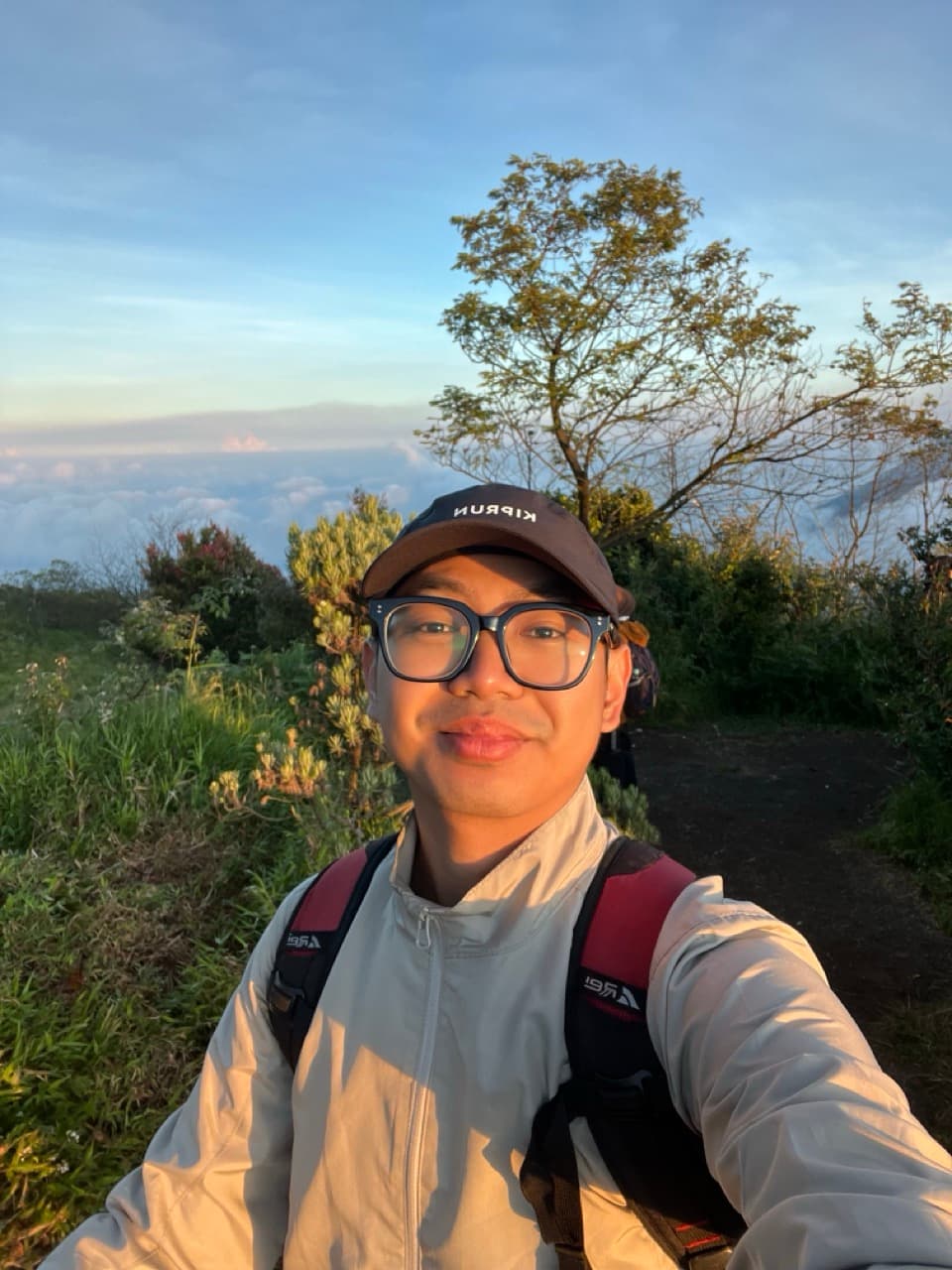
I also love being outdoors: nature, hiking, trees, and touching the earth. Time outside helps me think clearly and keeps my work in perspective.
Studying Computer Science at Universitas Gadjah Mada, 2024 to present. Based in Yogyakarta, Indonesia.
Contact
The next chapter is still open.
I am open to research, collaboration, and applied AI projects. If something here resonates with you, I would like to hear from you. That includes a problem you are stuck on and want to talk through.